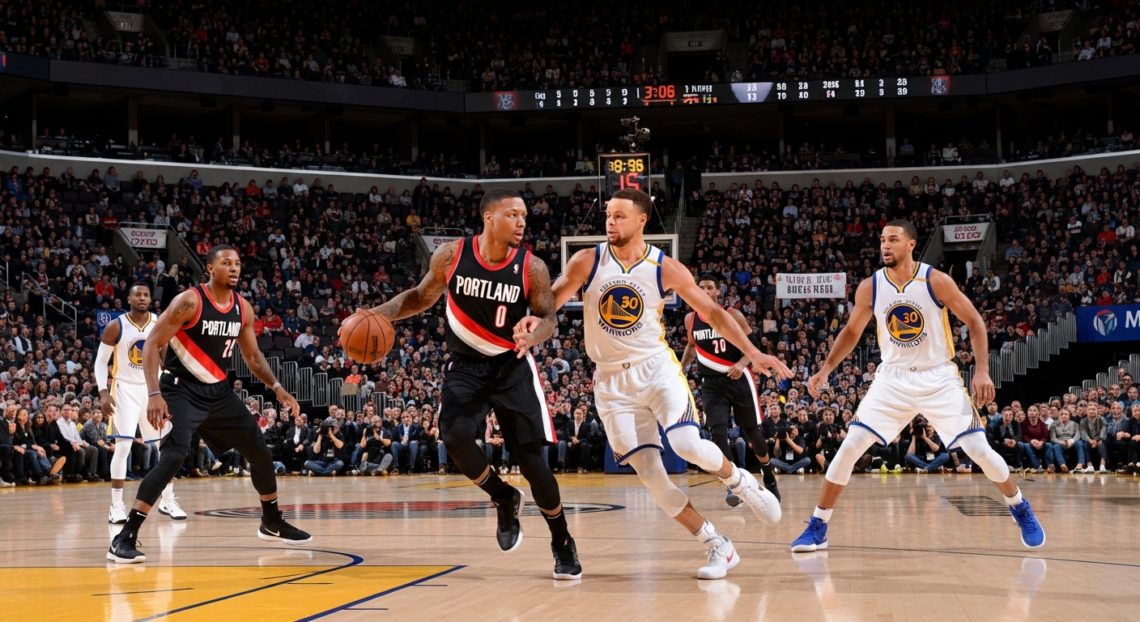
The Portland Trail Blazers faced off against the Golden State Warriors in a thrilling matchup that captured the attention of basketball fans around the world. Both teams showcased their unique strengths and star players, making this contest a high-intensity game from start to finish. In this article, we will break down the match player stats, key performances, and provide a detailed analysis of how each player contributed to their team’s effort.
Game Overview
The game between the Portland Trail Blazers vs Golden State Warriors was marked by fast-paced offense and tactical defense. The Trail Blazers, led by their dynamic backcourt, aimed to control the tempo, while the Warriors, known for their three-point shooting and ball movement, looked to exploit every scoring opportunity. The match featured several standout performances from both teams, making the stats a key element in understanding the flow and outcome of the game.
Portland Trail Blazers Player Stats
The Trail Blazers relied heavily on their star players to drive scoring and maintain momentum throughout the game. Key players such as Damian Lillard and Anfernee Simons were instrumental in keeping the team competitive against the Warriors.
Damian Lillard, as the team’s leading scorer, put up an impressive stat line with a combination of perimeter shooting and drives to the basket. His three-point accuracy and free-throw efficiency played a pivotal role in keeping the Blazers within striking distance. Lillard also contributed defensively, recording multiple steals and aiding in transition defense.
Anfernee Simons showcased his agility and scoring ability, adding crucial points off the bench and in key stretches of the game. His ability to create his own shot and attack the rim helped the Blazers stay aggressive offensively.
Jusuf Nurkić controlled the paint with rebounds, blocks, and second-chance points, demonstrating his value as a defensive anchor. His ability to secure boards on both ends of the floor provided the Trail Blazers with additional scoring opportunities and helped limit the Warriors’ inside game.
Other contributors, including bench players like Scoot Henderson and Shaedon Sharpe, added energy and versatility, ensuring that Portland could rotate efficiently and maintain pressure on the Warriors throughout the game.
Golden State Warriors Player Stats
The Golden State Warriors demonstrated why they are one of the most formidable teams in the league, showcasing exceptional ball movement, perimeter shooting, and veteran leadership. Stephen Curry led the charge, delivering an outstanding performance that combined long-range shooting with playmaking. His ability to stretch the floor created opportunities for teammates and kept the Trail Blazers’ defense constantly on alert.
Klay Thompson complemented Curry with his own sharpshooting, knocking down key three-pointers that swung momentum in favor of Golden State. His defensive efforts also contributed to containing Portland’s perimeter threats, making him an invaluable asset on both ends of the floor.
Draymond Green showcased his all-around skills, contributing in scoring, assists, rebounds, and defensive plays. Green’s ability to orchestrate the offense, provide rim protection, and make hustle plays was crucial for the Warriors’ success in this matchup.
Other role players, including Jordan Poole and Kevon Looney, added depth and consistency. Poole’s scoring bursts and Looney’s rebounding dominance further solidified Golden State’s advantage, particularly in controlling the tempo and exploiting mismatches.
Key Player Comparisons
When analyzing the Portland Trail Blazers vs Golden State Warriors match player stats, several head-to-head comparisons stand out. Damian Lillard versus Stephen Curry was arguably the highlight, with both players exchanging impressive scoring runs and showcasing their leadership under pressure.
Anfernee Simons’ agility and perimeter scoring provided a counterbalance to Klay Thompson’s sharp shooting. Meanwhile, the battle inside the paint between Jusuf Nurkić and Kevon Looney highlighted contrasting styles—Nurkić with raw power and agility, and Looney with smart positioning and efficient finishing.
Draymond Green’s versatility also set him apart, as he contributed across multiple stat categories, emphasizing the Warriors’ depth and teamwork. These comparisons demonstrate how individual performances and matchups significantly influenced the flow and outcome of the game.
Team Statistics and Performance
Beyond individual player stats, team statistics offer a clear picture of the matchup dynamics. The Warriors excelled in three-point shooting, ball movement, and fast-break points, leveraging their offensive system to stay ahead. Meanwhile, the Trail Blazers emphasized scoring versatility, relying on isolation plays, mid-range shooting, and strong defensive rotations to compete.
Rebounding was a critical factor, with both teams fighting for control of the glass. The Blazers’ frontcourt battled hard against the Warriors’ disciplined inside game, and second-chance points proved essential for both squads. Turnovers, assists, and free-throw percentages were also determining factors, shaping the rhythm and intensity of the match.
Highlights from the Match
Several highlights defined the Portland Trail Blazers vs Golden State Warriors matchup. Damian Lillard delivered multiple clutch shots in the final quarter, demonstrating why he is considered one of the league’s premier performers. Stephen Curry’s deep three-pointers and Klay Thompson’s shooting streaks electrified the arena and gave the Warriors a scoring edge.
Jusuf Nurkić’s defensive blocks and Draymond Green’s playmaking created key moments that shifted momentum. Bench contributions from Scoot Henderson, Shaedon Sharpe, and Jordan Poole added energy and depth, showing the importance of the full roster in high-stakes matchups.
Analysis of Player Efficiency
Analyzing player efficiency highlights how individual efforts translated into overall team performance. Metrics such as field goal percentage, three-point accuracy, rebounds per minute, and assist-to-turnover ratios offer insights into both teams’ strategic execution.
For the Trail Blazers, Damian Lillard and Anfernee Simons demonstrated high efficiency in scoring under pressure, while Nurkić provided consistent defensive contributions. The Warriors’ core trio—Curry, Thompson, and Green—showed exceptional efficiency in both scoring and facilitating plays, emphasizing Golden State’s balance and cohesion.
Efficiency statistics also reflect each team’s ability to adapt during the game. Portland’s reliance on isolation scoring contrasted with Golden State’s movement-oriented offense, highlighting different approaches to maximizing player contributions.
Impact of Coaching Strategies
Coaching strategies played a significant role in shaping player stats and team performance. Portland’s coach focused on leveraging Lillard’s offensive creativity, spreading the floor to create space for perimeter shooters, and emphasizing defensive rotations. Golden State’s coach implemented a high-tempo offense, encouraging ball movement and three-point shooting while relying on defensive discipline from Green and Looney.
Timeout decisions, rotation management, and in-game adjustments were reflected in the player stats, particularly in points scored during crucial stretches and defensive stops. Coaching philosophies directly influenced how each player executed their role and how the matchup evolved throughout the game.
Conclusion
The Portland Trail Blazers vs Golden State Warriors matchup provided fans with a spectacular display of basketball talent. By examining the player stats, we see the contributions of star performers, key bench players, and defensive anchors that shaped the outcome of the game. Damian Lillard and Stephen Curry led their teams with exceptional scoring, while other players like Anfernee Simons, Klay Thompson, Jusuf Nurkić, and Draymond Green added critical support across multiple facets of the game.
Ultimately, the stats not only highlight individual brilliance but also reveal the strategic depth, teamwork, and coaching adjustments that make NBA matchups like this so compelling. Whether it was clutch shooting, defensive plays, or overall efficiency, every player left a mark on the game, providing valuable insights for fans, analysts, and fantasy basketball enthusiasts.
FAQs
What were the top scorers in the Trail Blazers vs Warriors game?
Damian Lillard and Stephen Curry led their respective teams in scoring, with significant contributions from Anfernee Simons and Klay Thompson.
Who dominated the rebounds in the game?
Jusuf Nurkić and Kevon Looney were the leading rebounders, providing both teams with control of the paint and second-chance opportunities.
How did the bench players impact the game?
Bench players like Scoot Henderson, Shaedon Sharpe, and Jordan Poole contributed energy, scoring bursts, and defensive support, which were crucial during rotation periods.
Which player had the most efficient performance?
Stephen Curry and Damian Lillard had the most efficient scoring performances, with high shooting percentages and minimal turnovers.
Did coaching strategies influence player stats?
Yes, coaching strategies significantly affected player performance, including rotation decisions, offensive schemes, defensive matchups, and play-calling during critical moments.