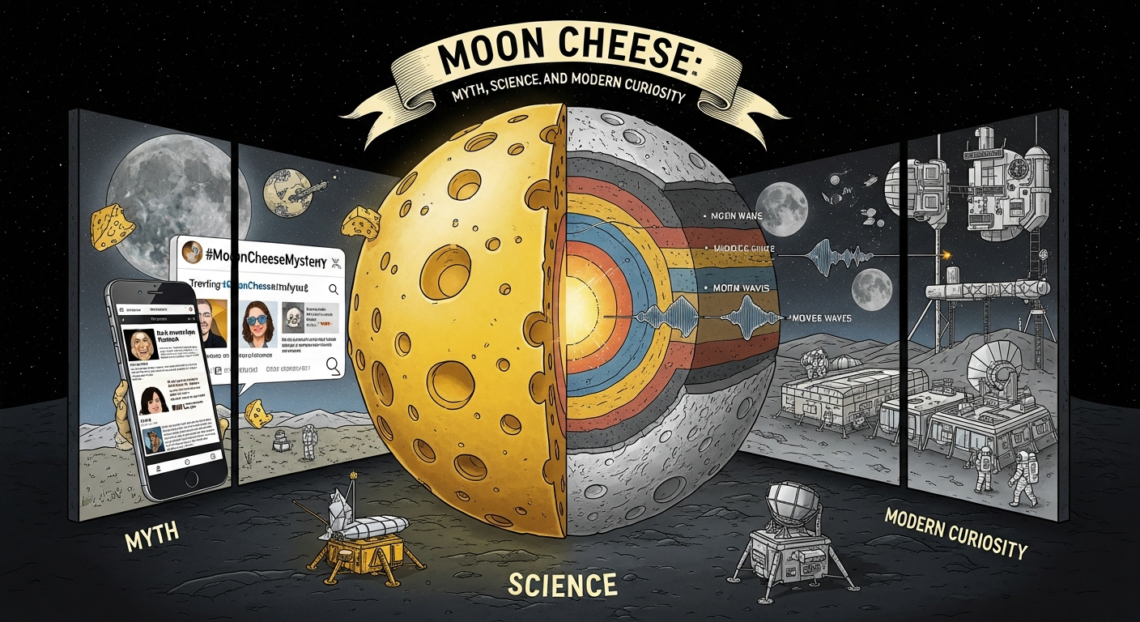
Moon cheese is a phrase that instantly sparks imagination. For centuries, people have joked, wondered, and even philosophized about the idea that the Moon might be made of cheese. While the concept began as folklore and humor, “moon cheese” has evolved into a cultural symbol, a scientific teaching tool, and even the name of a modern snack brand. This article explores the origins, meanings, and modern relevance of moon cheese, blending myth, science, and popular culture into one fascinating topic.
The Origin of the Moon Cheese Myth
The idea of moon cheese dates back hundreds of years. Long before telescopes and space missions, humans relied on imagination to explain the mysterious objects in the sky. The Moon, with its pale surface and dark spots, appeared similar to a wheel of cheese with holes.
In medieval Europe, stories and jokes about the Moon being made of cheese were common. These tales were not always meant to be taken seriously; many were humorous or symbolic. The phrase “the Moon is made of green cheese” became a way to describe something obviously false, often used to point out gullibility or naïveté.
Over time, moon cheese became a metaphor rather than a belief. It represented the human tendency to create explanations for the unknown using familiar objects from everyday life.
Moon Cheese in Folklore and Literature
Moon cheese has appeared in folklore, nursery rhymes, and literature across different cultures. In English-speaking regions, it often showed up in children’s stories as a playful idea. These stories encouraged imagination while subtly teaching skepticism.
In some folk tales, characters try to reach the Moon to taste its cheese, only to learn a lesson about greed or foolishness. Writers have also used moon cheese as satire, poking fun at blind belief or exaggerated claims.
Even famous authors referenced the idea to emphasize absurdity or wonder. Moon cheese became a storytelling tool that balanced humor and curiosity, making it memorable across generations.
Scientific Reality: What the Moon Is Really Made Of
Science eventually replaced myth with evidence. Through telescopes, lunar samples, and space missions, we now know that the Moon is composed of rock, dust, and minerals, not cheese.
The Moon’s surface contains materials such as basalt, anorthosite, and regolith. The cratered appearance that once resembled cheese holes is the result of asteroid impacts over billions of years. These impacts shaped the Moon’s surface into what we see today.
Moon cheese remains useful in science education. Teachers often mention it as a contrast between myth and reality, helping students understand how scientific knowledge evolves and why evidence matters.
Moon Cheese as a Cultural Symbol
Beyond myth and science, moon cheese has become a symbol in popular culture. It represents curiosity, imagination, and the playful side of human thinking. Saying something is “as likely as moon cheese” still suggests disbelief or humor.
In cartoons and movies, the Moon is sometimes still portrayed as edible, especially in children’s media. These portrayals keep the idea alive in a lighthearted way, reminding us that not all stories need to be factual to be meaningful.
Moon cheese also symbolizes how humans romanticize space. Before space travel, the Moon was distant and mysterious. Moon cheese captured that sense of wonder in a simple, relatable image.
Modern Uses of the Term “Moon Cheese”
In recent years, the term moon cheese has taken on new meanings. It is now commonly associated with branded snack foods, particularly crunchy cheese bites marketed as healthy or fun snacks. These products use the name “moon cheese” to evoke curiosity and nostalgia.
The term has also been adopted in marketing, social media, and creative branding. Businesses use moon cheese to suggest something playful, unique, or out of this world. The phrase is memorable and emotionally engaging, making it valuable in modern communication.
Moon cheese has also appeared in internet culture, memes, and casual conversation. It continues to evolve while retaining its roots in humor and imagination.
Interesting Facts About Moon Cheese (List Section Without Points)
The phrase “moon cheese” is believed to be several centuries old and was widely used in Europe.
Moon cheese is often paired with the phrase “green cheese,” which never referred to color but to young or unaged cheese.
Astronauts have repeatedly joked about moon cheese during interviews to connect science with humor.
The cratered surface of the Moon is the main reason early observers imagined it as cheese-like.
Moon cheese remains one of the most well-known examples of a scientific myth used for educational purposes.
Moon Cheese and Human Curiosity
Moon cheese is more than a silly idea. It reflects how humans approach the unknown. When faced with mystery, people create stories that make unfamiliar things feel approachable. Moon cheese transformed a distant celestial body into something understandable and even edible.
This habit continues today. While we no longer believe in moon cheese, we still use metaphors and imaginative language to explain complex ideas like black holes or quantum physics. Moon cheese reminds us that curiosity often begins with simple, even incorrect, ideas.
Rather than dismissing such myths, understanding them helps us appreciate how far human knowledge has come.
Conclusion
Moon cheese started as a playful explanation for the Moon’s appearance and evolved into a powerful cultural symbol. From folklore and literature to science education and modern branding, moon cheese has maintained its place in human imagination. While science has clearly shown that the Moon is not made of cheese, the idea continues to inspire humor, creativity, and curiosity.
Moon cheese teaches us an important lesson: myths are not failures of knowledge but stepping stones toward understanding. By exploring them, we learn not only about the universe but also about ourselves and how we make sense of the unknown.
Frequently Asked Questions (FAQs)
1. Is the Moon really made of cheese?
No, the Moon is made of rock and minerals. The idea of moon cheese is a myth and a humorous expression, not a scientific fact.
2. Why did people believe in moon cheese?
People used familiar objects like cheese to explain unfamiliar things. The Moon’s cratered surface resembled holes in cheese, inspiring the idea.
3. What does “green cheese” mean in moon cheese myths?
Green cheese refers to young or unaged cheese, not the color green. It was a common term in older English.
4. Is moon cheese used in modern times?
Yes, the term is used in branding, snacks, pop culture, and humor. It has become a nostalgic and creative expression.
5. Why is moon cheese still popular?
Moon cheese remains popular because it is simple, funny, and memorable. It connects imagination, history, and modern culture in an engaging way.